Bijapur to Hampi - 1991

Updated: Feb 7
Once my husband who is a Cardiologist was invited to give a lecture at Bijapur Medical college. To get there we went by train to Sholapur. On reaching we spent sometime in the market. Than we took a taxi to drive to Bijapur.
This memory evoked my mind to think of all that we saw in Bijapur and places we visited from there onwards.
Bijapur is in northern Karnataka, on the Deccan plateau. His lecture was held at a Medical college on the out skirts of the town. Next day we went around to see famous monuments in this city. Lot of this I knowledge I gathered after I visited Bijapur. I was familar with ' Gol Gumbaj ' from my studies at school.
It was ruled by The Adil Shahi dynasty (1490–1686)
What makes them special:
Great builders and patrons of art.
A culture that blended Persian, Turkish, Deccani, and local Indian traditions Bijapur was not just a political capital — it was a cultural one.
The monument we saw :

Gol Gumbaz (completed 1656)
Mausoleum of Mohammed Adil Shah
One of the largest domes in the world
No supporting pillars — an architectural marvel
The Whispering Gallery
Runs around the interior base of the dome
A whisper spoken at one point travels clearly across the gallery
Even small sounds are amplified and echoed many times
This happens because:
The perfect curvature of the dome
The smooth plastered surface
Circular sound-wave reflection
Bijapur mattered historically
Bijapur was:
A strong rival of the Mughal Empire
A major player in Deccan politics
Involved in alliances and conflicts with Vijayanagara, Ahmadnagar, Golconda, and Bidar.
Eventually:
In 1686, Aurangzeb captured Bijapur
It was absorbed into the Mughal Empire
The city slowly declined in political importance
But its buildings remained — quietly defying time.
Other remarkable sites in Bijapur
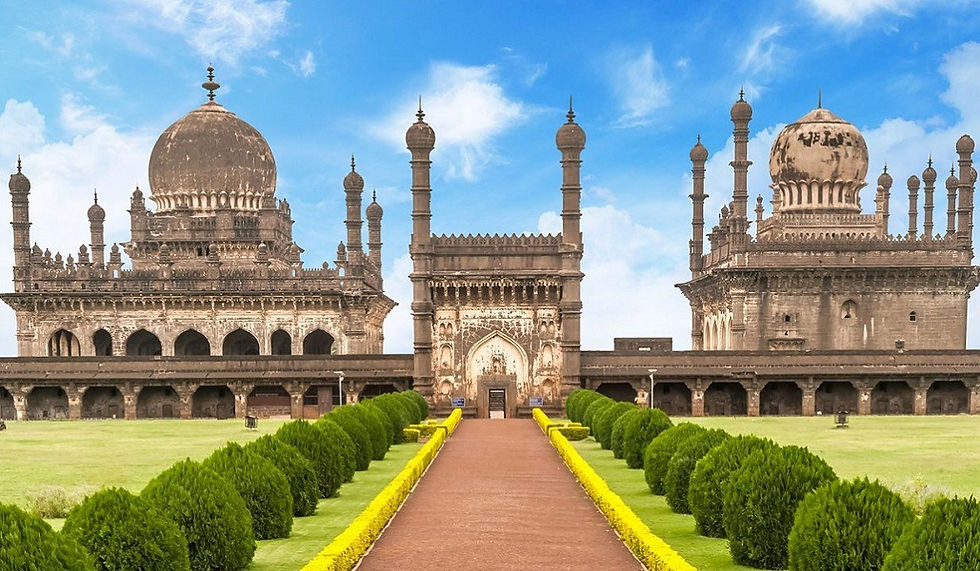
• Ibrahim Rauza: Often called the “Taj Mahal of the Deccan”. Elegant, balanced, and refined — many believe it inspired the Taj Mahal itself.

• Jama Masjid: One of the largest mosques in South India, unfinished but majestic.

• Bara Kaman: An ambitious, unfinished mausoleum meant to surpass Gol Gumbaz — ambition frozen in stone.
• Citadel & water systems: Advanced hydraulic engineering, stepwells, and aqueducts — essential in the dry Deccan climate.
A little history
Built in the early 17th century (around 1626)
Commissioned by Ibrahim Adil Shah II
The tomb houses Ibrahim Adil Shah II and his queen
Designed with extreme refinement — almost jewel-like compared to the vastness of Gol Gumbaz
If Gol Gumbaz overwhelms you with scale,Ibrahim Rauza wins you over with elegance.
One last gentle check
Gol Gumbaz → single massive domed structure.
Ibrahim Rauza → two graceful buildings side by side.
From Bijapur onwards we had a long journey passing thru small towns and villages. We went through the Badami–Aihole–Pattadakal circuit. These three are often visited together after Bijapur, especially on long interior journeys.
1️⃣ Aihole
Aihole is often described as an open-air laboratory of temple architecture
Why it feels like a “college”:
Over 120 small temples
Built between 6th–8th centuries
Different styles, plans, experiments — all in one place
No single grand monument, but many learning attempts
Historians believe:
Architects of the Chalukya dynasty tested ideas here
What worked was later refined elsewhere
It genuinely feels like students tried out designs before graduating to bigger projects
2️⃣ Pattadakal
Pattadakal was:
The ceremonial site of the Chalukyas
Where kings were crowned
Where architecture reached perfection, not experimentation
What makes it special:
Temples in both North Indian (Nagara) and South Indian (Dravida) styles
Standing side by side, harmoniously
A calm riverside setting (Malaprabha River)
If Aihole is the classroom, Pattadakal is the final exam result. Because it is orderly and balanced, it often doesn’t lodge as sharply in memory as Aihole or Badami — but historically, it is the crown jewel.
3️⃣ Badami Cave Temples:
Carved into red sandstone cliffs
Overlooking a tranquil tank (Agastya Tirtha)
Rock-cut caves dedicated to:
Shiva
Vishnu
Jain traditions
Many people remember
Climbing up to the caves
The vast landscape below
A sense of ancient stillness
Badami was also:
The capital of the Chalukyas
Older and more dramatic than the other two
Putting it all together
Bijapur → Islamic Deccan grandeur
Aihole → architectural experimentation
Pattadakal → architectural maturity
Badami → rock-cut spirituality and landscape
HAMPI

After Badami – Aihole – Pattadakal, most interior routes naturally leads toward Hampi. No one having come so far from Bijapur will go back without visiting HAMPI. Honestly speaking I knew very little about importance of Hampi.
Hampi offers a journey back in time, exploring vast ruins that reveal the grandeur of a lost empire, set in a unique natural environment, making it a treasure trove of history and natural beauty.
Hampi is a UNESCO World Heritage Site in Karnataka, India, featuring the sprawling ruins of the ancient Vijayanagara Empire, once a wealthy capital, set amidst a unique landscape of giant granite boulders and the Tungabhadra River. It's known as a vast open-air museum with stunning Dravidian temples (like Virupaksha & Vitthala), royal complexes, elephant stables, and vibrant markets, showcasing rich history, architecture, and Hindu culture from the 14th-16th centuries.
Hampi is very famous. Its a township, not just one monument. Situated right beside a large, important river Tungbhadra.
Building activity in Hampi continued over a period of 200 years reflecting the evolution in the religious and political scenario as well as the advancements in art and architecture. The city rose to metropolitan proportions and is immortalized in the words of many foreign travellers as one of the most beautiful cities.
Overwhelming in scale and history. Even people who forget names remember the feeling of Hampi — the rocks, the ruins, the river.
Deities & Temples:
Lord Virupaksha (Shiva): The main deity, with the ancient Virupaksha Temple dedicated to him and his consort, Pampadevi.
Hanuman: Hampi is considered his birthplace, featuring several shrines, like the Anjaneya Hill.
Lord Vishnu: Other prominent temples in Hampi are dedicated to Vishnu and his avatars, such as the Lakshmi Narasimha Temple and Krishna Temple.

The river: Tungabhadra:
The Tungabhadra River flows gently past Hampi.
It was:
The lifeline of the Vijayanagara Empire
A sacred presence
Why Hampi feels unforgettable
Hampi was the capital of the Vijayanagara Empire (14th–16th centuries), one of the richest and most powerful empires India has known.
Foreign travelers wrote:
“Streets full of jewels”
“Markets where diamonds were sold openly”
“A city larger than Rome”
And yet today:
Ruins scattered across hills
Temples, bazaars, royal enclosures
A silence that feels earned
That contrast stays with people.
Hampi is called the "Lost City" because after its capital of the powerful Vijayanagara Empire was sacked and destroyed by Deccan Sultanates in 1565 (Battle of Talikota), the once-grand city was abandoned, looted, and left in ruins for centuries, becoming forgotten until its ruins were rediscovered and brought to light in later centuries
Hampi offers a journey back in time, exploring vast ruins that reveal the grandeur of a lost empire, set in a unique natural environment, making it a treasure trove of history and natural beauty.


Comments