Visit to Sun Temples of India

Modhera Sun Temple.

It was built around 1026–27 CE during the reign of Bhima I of the Chaulukya (Solanki) dynasty. The approach to the temple is dominated by the extraordinary Surya Kund, the large stepped tank with numerous small shrines. Beyond it is the beautifully carved Sabha Mandap, followed by the main shrine. The temple was conceived in relation to the Sun and its movement, including the equinoxes.
Surya Kund Sabha Mandap Sabha Mandap Ceiling
Where Architecture Meets Astronomy
The Sun Temple at Modhera is remarkable not only for its exquisite architecture and intricate carvings but also for its astronomical significance. Built nearly a thousand years ago, the temple was carefully aligned with the rising Sun. On the days of the equinox, when day and night are almost equal, the first rays of the morning Sun were designed to travel through the temple towards the innermost sanctum, where the image of Surya once stood. The twelve representations of the Sun God, known as the Twelve Adityas, also symbolise the twelve months of the year. It is fascinating to realise that the builders combined their knowledge of the Sun's movement and the changing seasons with religious belief and architectural beauty. The temple is much more than a place of worship; it is a celebration of the Sun itself.
The Astronomical Significance
It is particularly fascinating. It was not merely a place of worship; its design also reflected the builders' understanding of the movement of the Sun and the changing seasons.
The temple faces due east and is carefully aligned with the rising Sun. On the two days of the year known as the equinoxes (around 20 March and 22 September), when day and night are almost equal in length, the first rays of the morning Sun were designed to pass through the entrance and the pillared halls, reaching the innermost sanctum where the idol of Surya once stood.
This was not merely an architectural achievement. It demonstrated an understanding of the Sun's annual movement and the changing seasons. There is another interesting detail, the temple walls feature the twelve forms of Surya, known as the Twelve Adityas, representing the twelve months of the year. Thus, the temple brought together astronomy, the calendar, religion and architecture in one remarkable creation, built nearly a thousand years ago.
Konark – The Sun God's Magnificent Chariot

Unlike Modhera, which has its beautiful stepped tank, or Martand, with its grand colonnaded courtyard, Konark was conceived as a gigantic stone chariot carrying Surya, the Sun God across the heavens.
This is a very different kind of Sun Temple. It is conceived as the magnificent stone chariot of Surya, the Sun God, with 24 enormous carved wheels and seven horses.
Let us begin with Konark Sun Temple in Odisha, perhaps the most dramatic of India's three great Sun Temples.
There are three remarkable features:
The 24 stone wheels
Each wheel is beautifully carved, with spokes and detailed ornamentation. The wheels are often interpreted as representing the passage of time. They also function as sundials, allowing time to be estimated from the shadows.
Seven horses
Seven hordes pull the chariot, traditionally associated with the seven days of the week and the movement of the Sun.
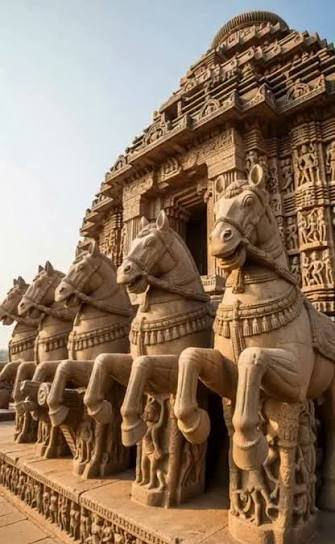
The extraordinary fine stone carvings
The walls are covered with sculptures of dancers, musicians, celestial figures, animals and scenes from everyday life. The temple is almost a gallery of medieval Indian art.
The dancers and musicians are especially fascinating. Their graceful poses and the many musical instruments they hold give us a glimpse into the performing arts of that time. Everywhere one looks, there is another detail to discover.
Martand – The Sun Temple of Kashmir

During my visit to Kashmir, I saw the magnificent ruins of the Martand Sun Temple, built in the 8th century by King Lalitaditya. Dedicated to Surya, the Sun God, it must once have been an extraordinary structure. Even today, its massive stone columns, open courtyard and surrounding walls give us an idea of its former grandeur. Set against the beautiful mountain landscape of Kashmir, the ruins have a special charm. Standing there, one cannot help imagining the splendour of the temple in its original form.


Comments