Argentina - 2006 - Part 2

Updated: Feb 12
This was our second visit to South America in 2006. We were again in S. America for a conference – divided between Chile and Argentina. My husband since he was attending a meeting was given a Visa to enter both Chile and Argentina only once. While for me as a tourist I could enter multiple times. If you look at the map below Chile and Argentina run parallel to each other going south. It would have been so nice if we could crisscross but that was not to be.


Lake District
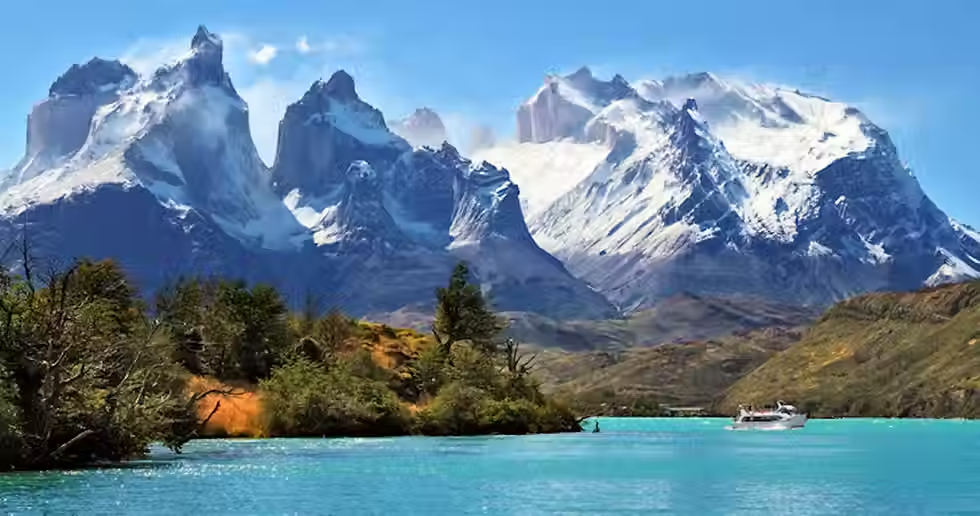
We crossed into Argentina somewhere midway, which is known as the Lake District. Stretching across the northwestern tip of Argentine Patagonia sits the picturesque Lake District. Sandwiched between the Andes Mountains with Chilean Patagonia to the west and Atlantic Patagonia to the east, the Lake District contains breathtaking vistas from nearly every angle.
It’s a land of glacial lakes with a backdrop of extinct volcanoes, their cones often coated with snow. There are swathes of bushy, barely touched forests. The air is Alpine-clear; the lake waters, a rhapsody of midnight blues.
The most famous town in this area is San Carlos de Bariloche. Famously called just Bariloche. We reached here by a boat journey. It very much reminds you of Austrian scenery. It is famous for local cheese. We were here just for a couple of days and of course we went to a restaurant for Swiss Fondue. A friend had advised us that he thinks San Martín de los Andes is prettier than Bariloche and not so commercial. It is much smaller in size. When we went there we found it too quiet.
From Lake District, we traveled by bus to reach Peninsula Valdes. It was a long journey. People were dropped off at different hotels and we were last to be dropped off at a very quiet hotel.
Peninsula Valdes
PENINSULA VALDES FOR UNIQUE WILDLIFE
Peninsula Valdés is a Patagonian nature reserve on the coast of Argentina. It is famous for four wildlife one can see here. These are Elephant seals, Sea lions and Megallen penguins. In the right season whale watching is also popular.
First day we went to see Elephant seals and sea lions. We saw them from the top of a cliff. As we went from one site to another our guide used to tell us how day by day Meallan Penguins are going back further south. Punta Tombo Penguin Colony is where we went on the last day and we saw about 15 -20 of them in the field.
From here we flew North to Buenos Aires for the conference. We were more familiar with the doctors here as we had been here earlier. In Chile no one spoke to us or were treated with friendly hospitality.
Once we reached Argentina we were very comfortable. At the party we were offered special Vegeterian Empanadas which were savory pastries made by folding dough over various fillings— cheese, vegetables. — These are like our Samosa.
On our second visit to Argentina my husband was attending a cardiac meeting. During the meeting a doctor sitting next to him was Dr. Robert Canessa. It came as a great surprise that a Paraguay rugby team’s member was sitting next to my husband during the meeting.
Dr. Canessa introduced him self to my husband that he was a Pediatric Cardilogitst. After that he started telling to my husband about his earlier experience. He said he was a student back then and a member of the Rugby team of his school. He was one of the player of the Rugby team. What he told next was a heart breaking story. He told my husband that he and his team were travelling to Chile for a match. And the plane carrying them crashed over the Andes mountain. He said he was part the group in of the Rugby team, in which very few survived. After that he and one of his friend walked down the mountain in search of help. They walked miles searching for help.
Who has not read or heard about this tragic crash. I live in India but I also had read the book written by him. The rumours say that there wasn't a single "lone survivor.
But rather a story of the Andes plane crash where a Paraguay rugby team was stranded after their plane crashed in the mountains in 1972. Sixteen people survived the initial crash, but they faced starvation and extreme cold, eventually resorting to cannibalism to survive. Two survivors, Roberto Canessa and Nando Parrado, set out on foot across the Andes, hiking for ten days to find help and eventually leading to the rescue of the remaining survivors.
Sixteen people survived the initial crash, but they faced starvation and extreme cold, eventually resorting to cannibalism to survive. Two survivors, Roberto Canessa and Nando Parrado, set out on foot across the Andes, hiking for ten days to find help and eventually leading to the rescue of the remaining survivors.
After the crash, the survivors endured extreme conditions and a lack of food. They were eventually forced to eat the flesh of the deceased to stay alive.
The Rescue
Roberto Canessa and Nando Parrado left the crash site to find help.
The Journey: They hiked across the mountains for about 10 days before finding a group of Chilean farmers.
The Result: Their efforts led to the discovery and rescue of the remaining survivors after more than two months in the mountains.
The story has been chronicled in the book Alive: The Story of the Andes Survivors and the films Alive (1993) and the Netflix movie La Sociedad de la nieve (2023), based on the book Society of the Snow. Dr. Canessa said, it was a practical decision and actually the least harrowing of the whole experience. He and Nando Parrado trekked 40 miles for 10 days in makeshift snow clothes from the wreckage to a mountain village. They were emaciated and dehydrated and yet these young men (practically teenagers) WALKED OUT OF THE ANDES after learning that the search had been called off and they were left for dead. THAT's a remarkable story of grit, determination that still inspires my daily life. I'm now 91 year old lady and I remain in awe of these men.
Of the 19 team members on the flight, seven of the rugby players survived the ordeal; 11 players and the team physician perished. Convinced that they would die …
I first learned of this story many years back, the year after the first book of the event was published. I've also now read three different memoirs of this account by three different survivors, including Dr. Canessa. It bugs me that journalists ALWAYS focus on the consumption of the deceased.
Like Dr. Canessa said, it was a practical decision and actually the least harrowing of the whole experience. He and Nando Parrado trekked 40 miles for 10 days in makeshift snow clothes from the wreckage to a mountain village. They were emaciated and dehydrated and yet these young men (practically teenagers) WALKED OUT OF THE ANDES after learning the search had been called off and they were left for dead. THAT's a remarkable story of grit, determination that still inspires my daily life. I'm now 92 and I remain in awe of these men. Asking about cannibalism in the midst of such remarkable human endeavour is so insulting to what these men endured.


Comments