Temple Tours Along The East Coast

Updated: Jun 6
Some years ago, we decided to go on a temple tour starting from Chennai. As we travelled along the coast, the journey itself became part of the experience. The humid sea air accompanied us throughout the drive, while coconut groves swayed gently beside the road. Across the flat landscape, huge temple towers would suddenly rise into view, their silhouettes visible from far away. We passed salt pans shimmering in the sunlight, quiet beaches touched by the waves of the Bay of Bengal, and old colonial buildings that hinted at the region’s long history. Between these sights were long stretches of road where the sea seemed endless, creating a sense of calm and openness that made the journey as memorable as the temples themselves.
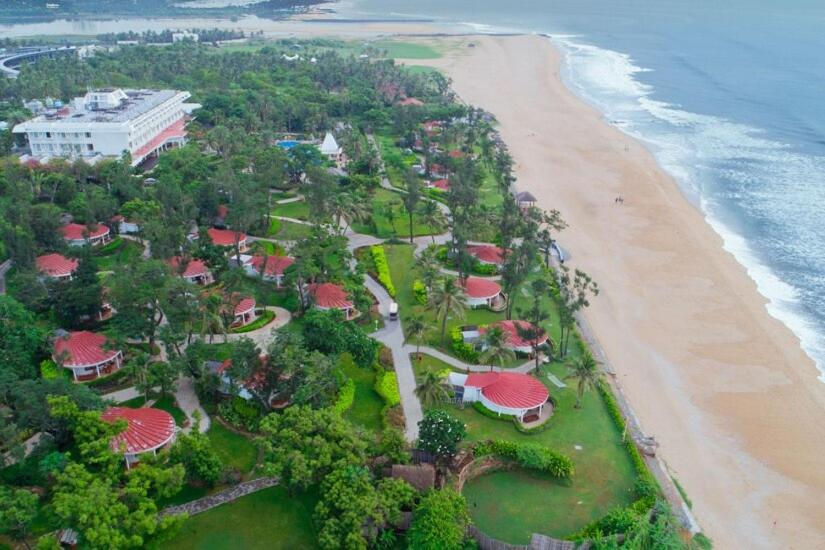
From Chennai, we straight away went to Taj Fisherman's Cove Resort & Spa near Mahabalipuram.
One distinctive thing about that property is that parts of it were built around remains of an old Dutch fort area, so it never felt like a city hotel. More like a quiet coastal retreat.
For many years, it was one of the classic first stops after arriving in Chennai. Situated directly on the shores of the Bay of Bengal and reached by the scenic East Coast Road, it offered a peaceful introduction to the region. The property consisted of a main building along with scattered cottages set among palm trees and well-kept lawns. Everywhere, the presence of the sea could be felt, with the constant sound of the waves providing a soothing backdrop and creating an atmosphere of relaxation from the moment of arrival. This is where Turtles to lay there eggs.
Mahabalipuram
Here we stayed at a hotel named Chariot. The name was given as one of the structure had a Chariot on the stone carvings.
The Pancha Rathas are especially memorable because each monument has been carved from a single massive rock, with every structure displaying a distinct architectural form and style. Standing in an open expanse of land, they resemble a remarkable stone sculpture park more than a conventional temple complex. Unlike many sacred sites, the atmosphere here feels strongly historical, inviting visitors to appreciate the artistry, craftsmanship, and experimentation of an earlier age. The granite itself bears the marks of centuries of sea wind, salt, rain, and sunlight, giving the monuments a tangible sense of antiquity. They feel ancient not just in history books, but in a deeply physical way that can be seen and touched.
Kanchipuram
Kanchipuram was another famous town that we visited during our journey. Known throughout India for its exquisite silk industry and beautiful handwoven sarees, it is also one of South India's most important temple cities. What makes Kanchipuram particularly interesting is that it contains both vibrant living temples, where daily worship and ceremonies continue uninterrupted, and older stone temples that feel quieter, more historical, and almost archaeological in character.
These older temples often leave a very different impression. Their weathered carvings, warm stone colours, peaceful courtyards, and sense of deep antiquity draw attention not to ritual but to art, architecture, and history. This distinction is something many travellers notice in South India. Some temples are experienced primarily as active religious centres, while others are appreciated as extraordinary historical and artistic creations.
In many of these older temple complexes, the atmosphere can feel almost timeless. Large trees cast shade over ancient stones, worn carvings reveal the passage of centuries, and the surroundings seem to invite quiet reflection rather than ceremony. During our visit, the area felt far less crowded than many such sites are today, allowing us to appreciate both the beauty of the architecture and the deep sense of history that these monuments preserve.
Kanchipuram is renowned for two things above all else: its magnificent temples and its famous silk industry, particularly the beautiful silk sarees that have made the city known throughout India. The city offers a fascinating blend of living religious traditions and historical architecture. Alongside large, active temple complexes where daily ceremonies and worship continue, there are also older and quieter stone temples that feel more like artistic and archaeological treasures.
Among the most memorable is the ancient Kailasanathar Temple, admired for its sandstone architecture, intricate carvings, and peaceful atmosphere. Visitors may also encounter larger and more active temples such as Ekambareswarar Temple and Varadharaja Perumal Temple, where the rhythm of worship remains an important part of daily life.
The older temples often leave a particularly lasting impression. Their weathered carvings, warm stone colours, quiet courtyards, and sense of great antiquity create an atmosphere that feels very different from that of active ceremonial centres. This distinction is something many travellers notice when exploring South Indian temples. Some are experienced primarily as living places of worship, while others are appreciated as extraordinary achievements of history, architecture, and artistic craftsmanship. Both perspectives are equally rewarding and together reveal the rich cultural heritage of the region.
Puducherry.
Puducherry has both French and Tamil sections.
We stayed at French section in the hotel of our favourite friend from Kerala - Casino group of hotels. Our hotel room was at the ground level right across from a swimming pool. The dining area was in the terrace. Every day we went for a walk by the sea. We were also lucky to find a good Italian restaurant close to our hotel. During our stay we visited the Tamilian section, especially again the Casino group Tamilian hotel with lots of Brass and Copper utensils for decoration.
Next we visited the place where Shri Aurbindo Ashram where we saw his Samadhi
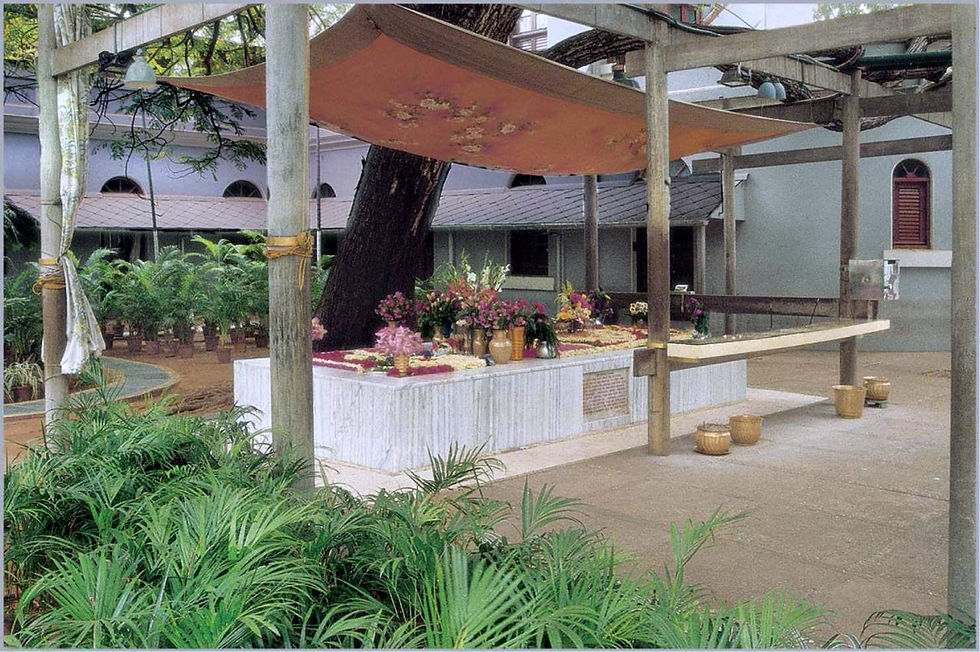
At the heart of the Ashram lies the Samadhi, a white marble shrine that houses the remains of Sri Aurobindo and The Mother. It is a place of silent meditation for devotees and visitors. The serene courtyard surrounding the Samadhi is one of Puducherry’s most visited and revered sites.

Finally a short visit where The Ashram has profoundly influenced modern Indian spirituality and education. It inspired the creation of the nearby experimental township Auroville, founded in 1968 by The Mother as a universal city dedicated to human unity. Today, the Ashram continues to attract seekers, scholars, and tourists interested in spiritual evolution and alternative living.
Chidambaram.
Nataraja Temple is very famous because Shiva is worshipped there as the cosmic dancer. Enormous gateways, dark stone halls, bronze images ,and a strange mixture of philosophy, dance, art, and devotion at the entrance. This temple feels intellectually and artistically important in South Indian culture.
Chettinad
After visiting Chiddambaram , we turned to Chettinad area. It is famous for its enormous mansion-like “havelis” belonging to wealthy merchant families.
The Chettinad region lies mainly around towns such as Karaikudi, Kanadukathan, and nearby villages in Tamil Nadu. It was home to the Nattukottai Chettiars, a remarkable trading and banking community. During the 19th and early 20th centuries, these families built great fortunes through trade and finance across Southeast Asia — especially in Burma, Sri Lanka, Malaya, and Singapore. Because of this wealth, they built extraordinary homes that almost look like palaces:
Huge courtyards open to the sky
Massive carved teak doors
Marble imported from Europe
Belgian glass chandeliers
Long pillared halls
Decorative tiles brought from abroad
Intricate woodwork and Athangudi floor tiles
Many of these mansions are so large that a single family house can occupy almost an entire street frontage. Walking through villages like Kanadukathan feels almost surreal — quiet streets lined with fading but magnificent mansions from another era.
The region is also culturally famous for:
Chettinad cuisine — one of the most distinctive food traditions of South India
Handmade Athangudi tiles
Antique wooden furniture
Temple architecture
A unique blend of Tamil and Southeast Asian influences
The Chettiar community became famous not only for business and banking, but also for education, philanthropy, and public life. Many influential industrialists, bankers, lawyers, and politicians came from this background. The atmosphere of Chettinad is very distinctive — elegant but quiet. Many travellers remember the long empty roads, huge homes with carved entrances, and a feeling that the region once held immense wealth and international connections. It almost feels like a forgotten trading civilization preserved inside rural Tamil Nadu.
The Chettinad region is in the southern part of the Indian state of Tamil Nadu.
It is not a separate district officially, but rather a cultural region centered mainly around:
Karaikudi
Devakottai
Kanadukathan
Pudukottai (partly connected culturally)
Several smaller heritage villages
Geographically, it lies roughly:
Southwest of Chidambaram
Inland from the Bay of Bengal
Between Madurai and the coast toward Rameswaram
Historically, the Chettiar merchants developed around a cluster called the “96 villages” of Chettinad. Their business networks spread across Southeast Asia, but their families continued building magnificent homes back in these Tamil villages.
One interesting thing is that the region itself is relatively dry and quiet — not lush like Kerala or dramatic like the Himalayas — yet the architecture is astonishingly grand. It surprises many visitors because the wealth appears almost suddenly in the middle of a rural landscape. While looking at visited Chettinad region through connections related to the Casino Group of Hotels, you probably experienced the region in a more traditional and heritage-oriented way.
Chettinad has become quite well known for heritage tourism because many old mansions have been converted into boutique hotels and traditional restaurants. Visitors are often taken through the mansion streets of Kanadukathan, antique markets around Karaikudi, traditional Chettinad dining halls, and old palatial homes with huge courtyards.
The food itself became famous all over India as “Chettinad cuisine,” though many dishes are traditionally very spicy and non-vegetarian. But even vegetarian travelers often remember:
elaborate banana-leaf meals,
pepper-based gravies,
kuzhi paniyaram,
coconut preparations,
and the atmosphere of old Tamil hospitality.
What is striking about Chettinad is that it does not feel like a royal kingdom in the way Rajasthan does. The wealth there came largely from merchant-bankers rather than kings. So the grand homes were built by private families, which gives the whole region a unique personality — almost like a rural financial aristocracy from another century.
We had lunch at the restaurant of Casino group. Later we stayed at a Bungalow in Karaikudi. Our hostess was a very refined lady. Her Bungalow was so designed with a garden in center and rooms around it.
Quite a few old colonial-era or Chettiar family homes were converted into elegant guesthouses called “bungalows” or heritage stays. The owners are often descendants of old Chettiar families or families associated with them socially and professionally connected with the rich of Chettinad community”
The Chettiar community historically formed a close commercial network. Some families became extraordinarily wealthy bankers and traders across Southeast Asia, while many others were associated through administration, accounting, law, education, or extended family relations. Even today, there remains a sense of an old cultured society built around education, etiquette, hospitality, and business reputation.
Many travelers mention refined hospitality rather than luxury in the modern hotel sense — quiet conversations, traditional meals, antique furniture, shaded courtyards, and a feeling of stepping into another period of Indian history.
Thanjavur
From Chetinad we were going to Tanjore - but on the way we decided to stay at a very modest place away from City. Food was good and staff was very cooperative.
Since we were three people they gave us a one of their largest room - not too far from the swimming pull area. At the back when you cross road there was larger area and many rooms laid out in a row. Behind was a small river flowing.
Instead of going to Tanjore city we decided to stay at this property and visited two temples of Brihadeshwar. Both were very ornate.
Brihadeswara Temple is very different from crowded ritual temples.
The Brihadeswara Temple is very different from many crowded ritual temples. It has a monumental quality, with vast courtyards, massive stone structures, and some of the finest achievements of Chola architecture. The temple conveys a sense of imperial power and grandeur, as though an entire empire has been carved into stone. Even visitors who are less interested in religious ceremonies often find themselves deeply impressed by the scale, artistry, and engineering of the monument. As we continued our journey, we were moving through the heart of the Chola region, one of the richest historical temple landscapes anywhere in India, where centuries of art, architecture, and history remain preserved in stone. This the richest historical temple landscapes anywhere in India.
The Brihadeswarar Temple, also known as the Big Temple, Rajarajeswaram, or Brihadisvara Temple, is one of the grandest temple structures in India. Built about a thousand years ago by the great Chola ruler Rajaraja Chola I, it stands as a remarkable symbol of the power, ambition, and artistic achievement of the Chola Empire.
Visits to Thanjavur are often combined with other magnificent Chola monuments nearby, particularly the Airavatesvara Temple near Kumbakonam and the Gangaikonda Cholapuram Temple. Together, these three extraordinary monuments are celebrated today as the “Great Living Chola Temples,” representing some of the finest achievements of South Indian architecture and temple building.
Rameshwaram
From Thanjavur we went to Rameshwar and stayed at a hotel on the out outskirt of town. Rameshwar temple is my favourite. It has a large number of pillars along the wall and after that you see Devsthan.
The temple itself stands on Rameswaram Island, close to the sea, and the atmosphere there feels different from inland temple towns. There is salt in the air, pilgrims arriving after long journeys, and a sense of being at the edge of the land facing the ocean toward Sri Lanka.
Traditionally, the temple is associated with the story that Rama worshipped Shiva here after the war in Lanka, which is why it became one of the holiest pilgrimage sites in India. But even apart from mythology, the physical experience of the temple is unforgettable — the vastness of those corridors, the geometry of the pillars, and the feeling of slowly moving inward toward the sanctum.
For many travelers, Rameswaram is less about a single moment and more about movement itself: walking through corridor after corridor, light fading and returning between the columns, until finally reaching the inner shrine.
The crossing toward Rameshwar is unique - especially the old Pamban Bridge - feels unforgettable. The sea on both sides, fishing boats below, wind and air all around and the sense of travelling towards very edge of India. We went there just to see crossing of the trains.
We also went to walk around the village of Fisherman close to the bridge. It was a unique experience. We also decided to go in a Jeep to drive from one Island to another. Our private driver was reluctant to take us even up to where the Dhanushcodi starts.
For this we asked the hotel staff to get us a person who would take us in a Jeep from one island to another. A hefty man looking like one from fisherman community arrived to pick us up.
When we reached close to Islands he handed us over to a real fisherman.
We tried out to go from one to next for about three islands. We saw a bus coming along with full of local people. But we gave up our attempt to go further. Perhaps if we knew it would have been safer to go on a bus like that.
After turning back I rang up our driver to come to pick us up as the road was perfectly smooth. This time he could not refuse us as I told him that road is safe most of the people have come in there own cars.
Next day we left from Rameshwar to go to Madurai.
Madurai
The great temple of Madurai is the Meenakshi Amman Temple, one of the most remarkable temple complexes in India and one of the finest achievements of Dravidian architecture.
What makes the temple unique is that it is dedicated not only to Shiva but also to his consort Meenakshi, regarded as a form of Parvati. In fact, the temple's central story revolves around Meenakshi herself, which is unusual because most major South Indian temples place the male deity at the center.
According to tradition, Meenakshi was born as a princess of Madurai and later married Shiva, who came to Madurai in the form of Sundareshwarar ("the Beautiful Lord"). Their divine marriage is still celebrated annually in a grand festival that attracts enormous crowds.
What makes the temple unique is that it is dedicated not only to Shiva but also to his consort Meenakshi, regarded as a form of Parvati. In fact, the temple's central story revolves around Meenakshi herself, which is unusual because most major South Indian temples place the male deity at the center.
When you approached the temple, the first things you would have noticed were the towering gopurams (gateway towers). There are many of them, covered with thousands of brightly painted figures of gods, goddesses, demons, animals, and mythological beings. The tallest rise over 50 meters above the city and have become the symbol of Madurai itself.
Inside the temple complex, several features stand out:
The Golden Lotus Tank, a sacred water tank where pilgrims pause before entering deeper into the temple.
The Hall of a Thousand Pillars, famous for its carved columns. The actual number is slightly less than a thousand, but the hall creates an extraordinary visual effect with its long rows of pillars.
Numerous shrines, corridors, and mandapams filled with sculptures depicting stories from Hindu mythology.
Musical pillars that produce different notes when gently tapped.
The architecture creates a sense of progression, as if one is moving from the busy outer world toward something increasingly sacred. Historically, the temple reached much of its present form under the Tirumala Nayaka and other rulers of the Nayak dynasty during the 16th and 17th centuries. While the site is much older, these rulers expanded it into the vast complex seen today.
For many travelers, Madurai is not just another temple town. The temple stands at the heart of the city, and the city itself seems to have grown around it. Even today, when viewed from above, the streets radiate outward from the temple in concentric patterns, showing how deeply it has shaped Madurai's history and identity.
Since I visited many years ago, I suspect what remains most vivid is not a particular sculpture or shrine, but that unforgettable experience of walking through those immense stone corridors, watching the light and shadows fall across the pillars as you slowly approached the inner sanctum. That memory stays with me long after individual details have faded.
Kumbakonam
Unfortunately we didn’t visit Kumbakonam and I had very little knowledge about this city back then.
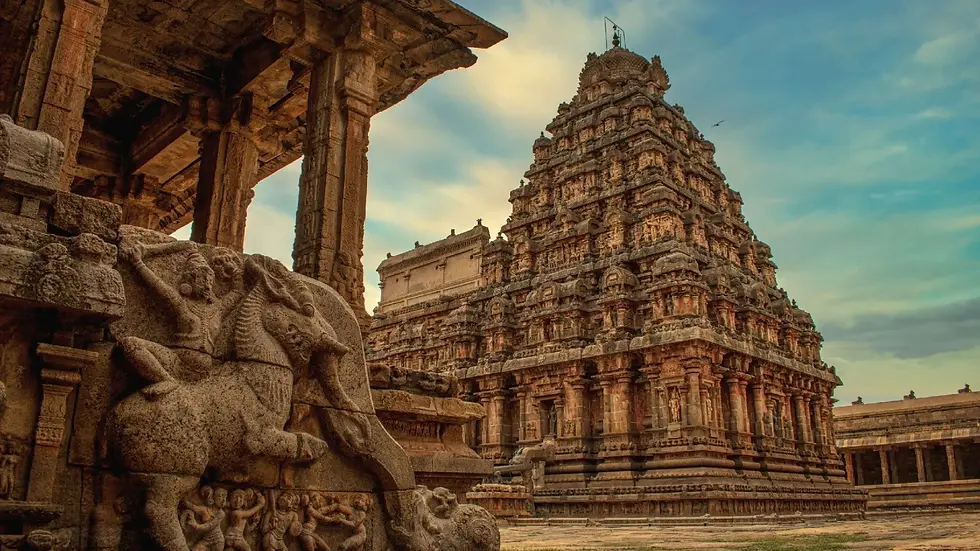
I have heard about four Surya Temples of the East and West.
East is Konark Sun Temple in Odisha, while at west is Modhera Sun Temple in Ahmedabad. For North in Kashmir after leaving Pehalgam our driver at my request drove towards Anantnag and took us to what is considered
Surya temple. Finally I was looking for same in South and I was told that is in Kumbakonam.
Kumbakonam is surrounded by many ancient temples and temple tanks. Travellers often stay there while visiting several old Chola-era temples nearby.
The whole region is filled with: river branches, coconut groves, stone temples, bronze traditions and very old sacred towns.
Sometimes memories from this area merge together because temples appear one after another across the countryside.
Gangaikonda Cholapuram

This temple often leaves a quieter impression than Brihadeswara
It is less crowded, more isolated, softer architectural lines, and surrounded by rural landscape. Many people who enjoy atmosphere and history remember it very fondly.
Airavatesvara Temple
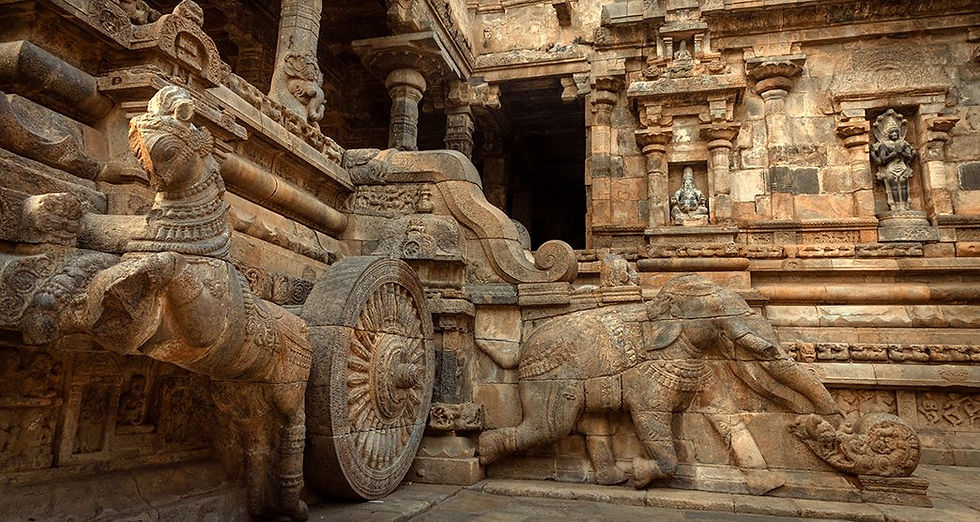
This temple is smaller in scale than some of the great Chola monuments, but it is renowned for its extraordinary refinement and artistic detail. Delicate carvings cover much of the structure, showcasing the remarkable skill of the craftsmen who created it centuries ago. It is also famous for its musical stone steps, which are said to produce different notes when gently tapped. Everywhere one looks, there is exquisite sculptural work that rewards careful observation. From the way These quieter and older Chola temples may have remained with me even more strongly than the larger and busier ceremonial temples, because of their atmosphere, artistry, and sense of timelessness.


Comments