Uzbekistan
- Usha Shah
- Mar 19
- 5 min read

My last trip outside India was Uzbekistan. In the same year we four friends decided to visit Uzbekistan.
We travelled from Mumbai airport to Delhi. The plane connection to reach Tashkent the capital city, was in the early in the morning .
So at Delhi Airport we spent the night so that we can reach the early morning next day. There was an arrangement at the Airport where small cubicles with all the facilities were available across the road. With the help of our porters we reached safely and checked in. We took a short nap and were ready to cross the road and get back, we were told that it is not possible. We pulled our luggage and got back across the road.
We were lucky that our guide from Uzbekistan was waiting for us at the gate and travelling with us. That was a great relief. On reaching we reached our hotel “ HILTON “ which was located right across the road.
Uzbekistan is a country with a deep historical atmosphere. Cities like Samarkand, Bukhara, and Khiva almost feel like a living museums on the old Silk Road.
Uzbekistan was one of the central regions on the old Silk Road, and it was strongly connected with the empire of Timur, who made Samarkand his capital in the 14th century. Many of the blue-tiled buildings there date from his time or from his descendants.
It is a wonderful country for sightseeing, especially if one enjoys history, architecture, and the atmosphere of the old Silk Road. Many cities there were once major stops for traders traveling between China, India, Persia, and Europe.
Tashkent

It is the capital city where usually travellers arrive. There is a lot to see here, such as the Khast Imam Complex – a historic religious complex with old madrasas and mosques. The Chorsu Bazaar, a traditional Central Asian market under a large blue dome, where we bought some ry fruits.

Then there is Amir Timur Square – a central square with a statue of the famous conqueror.

We also saw the statue of Lal Bahadur Shastri. The statue is located in the central part of the city itself, near the intersection of Sadik Azimov Street and Taraqqiyot Street.

We also went to the State Museum of Applied Art (Tashkent) which Showcases traditional Uzbek weaving, Ikat, embroidery , carpets, and clothing.
Tashkent is more modern than other Uzbek cities because much it was rebuilt after a 1966 earthquake. Now they also have electric trains running from one end to the other. One more thing i observed was their wide roads going up and down and a patch of greenery in the middle of the road where people would even relax. We spent almost half a day at Chimgan Ski Resort, Often called the “Uzbek Switzerland,” this is a popular, historic, and family-friendly area known for its gentle slopes, and activities like horse riding and sledding. On our return from the ski resort, on the way down we saw the famous man made lake called Charvak Reservoir. This stunning turquoise-colored, man-made alpine lake, surrounded by mountains, is a top summer destination offering beaches, swimming, paragliding, and boating, popular with locals and tourists alike.
From here we travelled by train to Samarkand.
Samarkand
This is the most famous Silk Road city. It was the capital of the empire of Timur. Some of the most important and interesting places to visit are, The Register Square, Then The Gur-e-Amir – tomb of Timur and Shah-i-Zinda – a long avenue of colorful tiled mausoleums.
Many travelers feel that Samarkand looks like something from a fairy-tale of the Silk Road.


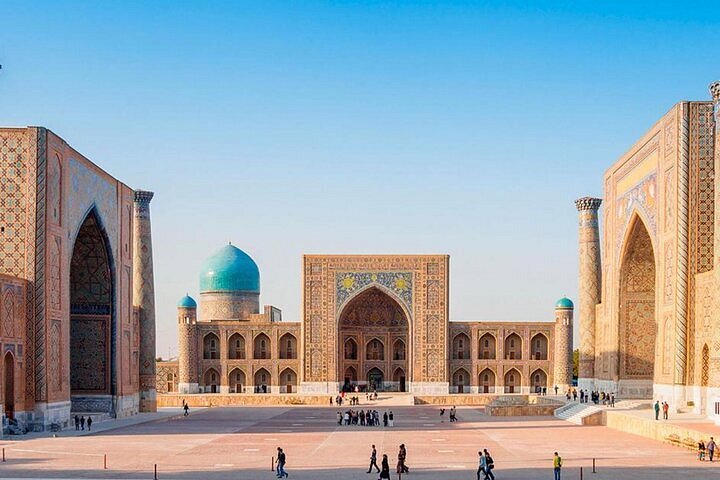
Registan — the Heart of Samarkand
In the historic city of Samarkand, the Registan Square is considered one of the most magnificent architectural spaces in the world. For centuries it was the central public square of the city — the place where people gathered for markets, royal announcements, ceremonies, and festivals.
The word “Registan” comes from Persian and means “sandy place” or “desert square.” Long ago, the square was simply an open sandy area where caravans and town's people assembled. What makes Registan so extraordinary is the perfect balance of the buildings.
You see there enormous arched entrances, the tall minarets the turquoise domes, the walls covered with blue, turquoise, and yellow tile mosaics. The patterns include geometric designs, floral motifs and arabic calligraphy. When the sunlight falls on the tiles, the buildings glow in shades of blue.
Registan in the Time of Timur
During the time of Timur, this area already functioned as the main public space of Samarkand, although the buildings we see today were constructed mostly during the Timurid and later periods. Here rulers made announcements, merchants gathered, and public celebrations were held. Even today, when people walk into Registan Square, they often feel a sense of awe and silence.
Travel writers frequently compare it to other famous historic spaces such as St Mark's Square or Tiananmen Square. But Registan has a different atmosphere, a more ancient and mysterious, connected with the long history of the Silk Road.
Many historians believe Samarkand under Timur rivaled cities like Baghdad and Constantinople in wealth and beauty. Registan, it is one of the most beautiful squares in the world, surrounded by three magnificent madrasas.
The Three Great Madrasas
The square is surrounded on three sides by three enormous madrasas (Islamic schools). These buildings form one of the most harmonious architectural ensembles anywhere in the world.

1. Ulugh Beg Madrasa (built 1417–1420)
This was the first building constructed in the square.
It was built by Ulugh Beg, the grandson of Timur.
Ulugh Beg was not only a ruler but also a great scholar of astronomy and
mathematics.
A huge entrance arch (called a pishtaq)
Elegant blue tilework with geometric star patterns
Student rooms arranged around a courtyard
This madrasa was one of the most famous centers of learning in Central Asia.
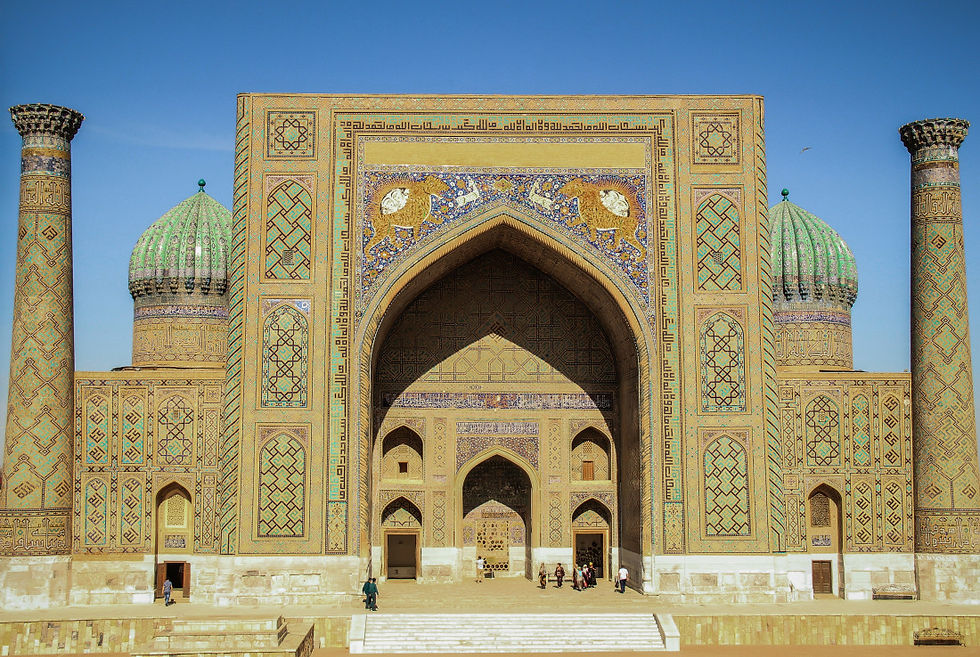
2. Sher-Dor Madrasa (built 1619–1636)
About 200 years later, another madrasa was built directly opposite Ulugh Beg’s. Its name means “House of Lions.” On its entrance façade you can see a rare design in Islamic art:two tiger-like animals chasing deer with a sun above them. This is unusual because animal images were rarely used in Islamic religious architecture.

3. Tilya-Kori Madrasa (built 1646–1660)
This madrasa completed the square.
The name Tilya-Kori means “gilded” or “covered with gold.”
Inside is a magnificent mosque with:
gold-covered decoration
richly painted ceilings
elaborate patterns
The interior shines beautifully when sunlight enters.
From here we travelled to Bukhara by train.
Bukhara


Bukhara is more compact and historic. Walking through its old town feels like going back many centuries.
Major sights to visit would be:
Po-i-Kalyan Complex – includes the famous Kalyan Minaret.
Ark of Bukhara – the ancient fortress of the rulers.
Lyabi-Hauz – a peaceful square around a pond with old buildings.
Bukhara was once an important center of Islamic learning in Central Asia.
From Bukhara we travelled to Khiva by car. It was a long 8 hour car journey.
Khiva
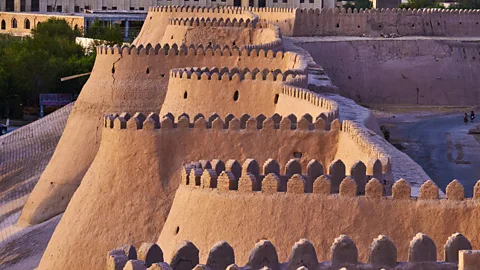

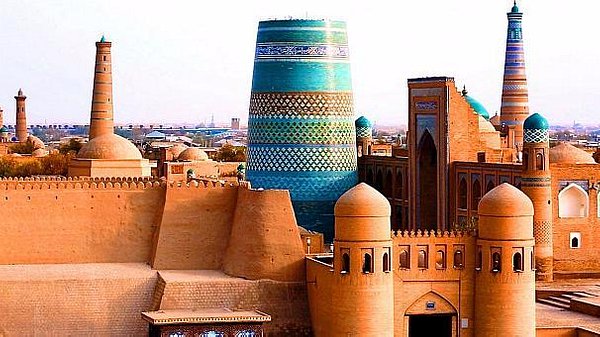


Khiva is almost like a living museum. The old walled city, Itchan Kala, is a UNESCO World Heritage site. Inside the walls you see, blue-tiled minarets, madrasa courtyards, old city gates and narrow streets that look almost unchanged from medieval times. We also saw the famous Juma Mosque which is famous for its forest of wooden pillars inside.
Nature and other places
Besides historic cities, there are also natural sights. Aral Sea region is famous for the environmental disaster where the sea largely dried up. SO the story goes, that the Amu Darya river is dried up primarily due to massive, unsustainable water diversion for cotton agriculture, particularly in the Soviet-era expansion of irrigation canals, which has caused it to stop reaching the Aral Sea. Due to this the Aral Sea receeded to such an extent that the fishermen lost their livelihood. Then there is Kyzylkum Desert with its vast desert landscapes and Nuratau Mountains for the villages and nature.
Tashkent → Samarkand → Bukhara → Khiva.
This route follows the old Silk Road cities and shows the best architecture of Central Asia.


Comments