Visit to Taiwan


Once while we were in Tokyo from there we went to Taiwan to attend “ World Congress of Cardiology “ which was held in the city Taipei.
Fortunately I met an Indian lady who happily took me first around the city. At night she took me to see Night Bazar. These are common in Thailand and other surrounding countries also. During this trip we visited the National Palace Museum.

Next day delegates of the meeting were taken there, so I went twice.
After that we took a long drive by car and saw surrounding. At the end the driver took us a to see a quarry of Alabaster where people were carving on stones.
National Palace Museum
It is sometimes confusingly described as the Chinese National Palace Museum, but its proper name in Taiwan is simply National Palace Museum.
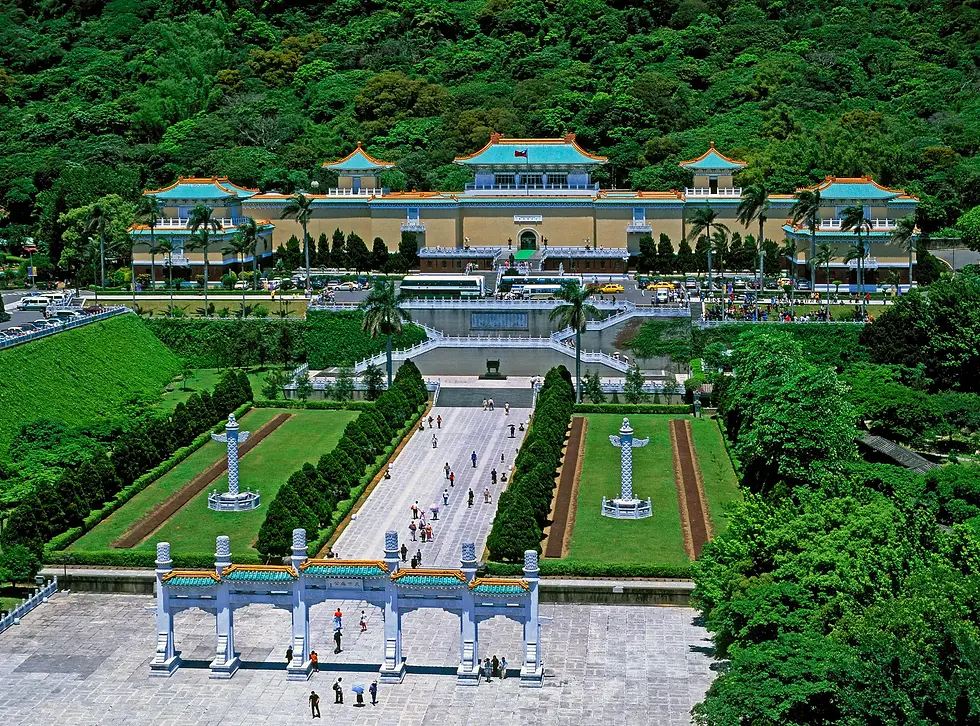
During those days it displayed an extraordinary collection of Chinese imperial art and treasures, much of which was brought from mainland China to Taiwan during the Chinese Civil War in 1948–49.
The collection includes paintings, calligraphy, jade, ceramics, bronzes and imperial objects accumulated over centuries. The building itself has a distinctive traditional Chinese architectural appearance, with its sweeping rooflines, broad stairways and palace-like design. The collections came largely from the former Palace Museum and the National Central Museum and were moved to Taiwan during the Chinese Civil War, the two collections were united in Taipei in 1965.
And the Jade collection is remarkable. One particularly famous object is the Jadeite Cabbage, carved to resemble a head of Chinese cabbage, complete with tiny insects on its leaves.
Jadeite Cabbage —The Famous Little Cabbage

This is probably the object i remember clearly. It is a small carving from one piece of jadeite, using the natural white and green colours of the stone to create a Chinese cabbage. On the leaves are a katydid and a locust.
What makes it wonderful is that the artist didn't simply carve a cabbage — he looked at the imperfections and colours already present in the stone and turned them into the vegetable. It is a lovely example of the Chinese idea of making the most of what nature gives you.
Meat-shaped Stone

This is the amusing one. At first glance it looks like a beautifully cooked piece of braised pork belly. It is actually jasper. The craftsman used the natural layers of the stone for the fat and lean meat, coloured the upper surface, and even made tiny holes to imitate the pores of pork skin. It is one of those objects where you stand there thinking, Surely that isn't stone!
Mao Gong Ding
This is much more serious and historically important: a large Western Zhou bronze ritual vessel, dating to roughly the 9th century BCE. Its importance isn't only its age. It carries a long inscription inside, which gives historians valuable information about early Chinese history and writing. It is traditionally counted among the museum's great treasures.
Enormous World of Jade
The museum has jade objects going back thousands of years — ritual jades, ornaments, vessels, animals and wonderfully small carved objects. The museum's own suggested route includes pieces from the Longshan culture, around 2200–1900 BCE, showing how extraordinarily early sophisticated jade working had developed. Some are tiny. Some are almost abstract. Some are animals or mythical creatures. They are not necessarily spectacular in the way a huge statue is spectacular — you have to look closely.
Chinese porcelain
This is another major treasure of the museum — especially Ming and Qing imperial porcelain.
Look for:
blue-and-white porcelain
celadon
famille-rose pieces
imperial Qing porcelain
unusual vessels made for the court
pieces whose shapes imitate flowers, animals or other objects.
The really interesting thing is the progression through the dynasties. You can see how decoration, colour and technical skill change over centuries.
Chinese paintings
Don't overlook these. The museum has an exceptional collection of Chinese painting and calligraphy, including landscape paintings, court paintings, figures, flowers and birds. Chinese paintings can look deceptively simple to someone accustomed to Western painting. A few brush strokes may represent mountains, trees, mist and water. The empty space is part of the painting. And the long handscrolls are particularly fascinating. You gradually unroll them and encounter a landscape or story almost as though you are travelling through it.
Calligraphy

This is another enormous part of the collection. Chinese calligraphy isn't simply handwriting. The brushwork itself is considered an art. You will see the development of different styles over many centuries. If you don't read Chinese, don't worry. You can still appreciate the rhythm and movement of the brush.
Buddhist sculpture

There are beautiful Buddhist sculptures from different periods — stone, wood and metal figures of Buddhas and bodhisattvas.
Rare books and documents
And then there is something people often forget: books. The National Palace Museum has an enormous collection of rare books, manuscripts and historical documents. When the Palace Museum and the National Central Museum collections were brought together in Taipei in 1965, they contained more than 545,000 rare books and documents from the Palace Museum alone. The collection includes imperial books from the Qing court, ancient manuscripts, woodblock and movable-type editions, maps, local histories and Buddhist scriptures.
Some of these books are themselves works of art — beautifully printed, written or illustrated.
So the National Palace Museum is not simply a museum of beautiful objects. Its books and documents preserve the written memory of Chinese civilisation.


Comments