Turkey

Updated: Jun 27

My visit to Turkey was organised by a friend. We were eight people in all.
We flew to Turkey from Mumbai. We arrived in Istanbul and stayed on the European side of the city. We stayed in newer part- I am not sure about the name. Across the Bosphorus lay the Asian side, visible yet belonging to another continent. As a tourist, I found this geographical fact quite remarkable. Few cities in the world can claim to stand on two continents at once. Watching the ferries move constantly between Europe and Asia added a special charm to our stay.

Turkey had fascinated me for many years. Situated between Europe and Asia, it occupies a unique place on the map and in history. When I finally visited, I discovered that Turkey was much more than the stories I had read. It was a land of striking landscapes, ancient civilizations, beautiful coastlines, bustling cities, and warm hospitality. As a tourist, I found myself moving through places where Roman, Byzantine, Ottoman, and modern influences seemed to exist side by side. This journey gave me an opportunity to experience a country that is both familiar and different, traditional and modern at the same time.
The Ottoman refers to the people, rulers, culture, and empire associated with the Ottoman Empire, one of the world's great empires. The empire was founded around 1299 by Osman I, from whom the name "Ottoman" is derived (Osman became "Ottoman" in European languages). Over the centuries, the Ottoman Empire expanded across parts of Europe, Asia, and Africa.
Ancient Turkey → Greeks, Romans, Byzantines
Medieval to modern Turkey (1300–1922) → Ottomans
Modern Turkey (from 1923) → Republic founded by Mustafa Kemal Atatürk. In my school days in our book I had read about Mustafa Kemal Atatürk.

As a tourist in Turkey, when people speak of "Ottoman," they are usually referring to: Ottoman architecture — grand mosques, palaces, fountains, and bridges. Ottoman culture — traditions, art, calligraphy, music, clothing, and cuisine. Ottoman rulers (Sultans) who governed the empire. Ottoman history, especially from the 14th to the early 20th century.
The Ottoman Empire ruled vast territories for more than six centuries, from the early fourteenth century until 1922. Its legacy can be seen throughout Turkey in magnificent mosques, palaces, bridges, markets, and public buildings. Places such as Topkapı Palace, the Blue Mosque, and the Süleymaniye Mosque are reminders of the wealth, power, and artistic achievements of the Ottoman rulers. Even today, Ottoman influences can be seen in Turkish architecture, cuisine, decorative arts, and cultural traditions.
Our first destination in Turkey was Istanbul. We stayed on the European side of the city, across the Bosphorus from the Asian side. This was my first experience of a city that actually spans two continents. From the beginning, I was fascinated by the idea that a short journey across the water could take one from Europe to Asia. The Bosphorus was not merely a waterway but a living reminder of Istanbul's unique position between two worlds. We did most of our sightseeing in Istanbul on the asian side.
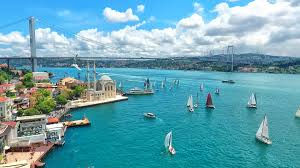
Although we stayed on the European side of Istanbul, much of our sightseeing was on the Asian side. We enjoyed crossing the Bosphorus and seeing the city from the water. The Asian side felt less crowded with tourists and gave us a glimpse of everyday life in Istanbul. The ferry journeys, with the skyline of mosques and palaces spread across the strait, remain among my strongest memories of the city.
We could look across the Bosphorus and see some of Istanbul's most famous landmarks on the European side:
Topkapı Palace — the residence of the Ottoman sultans for centuries.
Hagia Sophia.
Blue Mosque.
The historic peninsula of old Istanbul spread out along the shore.
Topkapı Palace Topkapı Palace Inside Hagia Sophia Hagia Sophia Inside Blue Mosque Blue Mosque Inside
For our sight seeing we went to most of the places , accept capital city Ankara.
We visited Troy, Trojan Horse, Izmir,Antalya, Ephesus, Cappadokia, and Sufi town - Konya,
Troy
Troy was repeatedly destroyed and rebuilt during its 4000 years of settlement. As a result, nine archaeological layers have been identified at the site, each corresponding to a city built on the ruins of the previous. Archaeologists refer to these layers using Roman numerals, Troy I being the earliest and Troy IX being the latest.

Troy was first settled around 3600 BCE and grew into a small fortified city around 3000 BCE (Troy I). Among the early layers, Troy II is notable for its wealth and imposing architecture. During the Late Bronze Age, Troy was called Wilusa and was a vassal of the Hittite Empire. The final layers (Troy VIII–IX) were Greek and Roman cities which served as tourist attractions and religious centers because of their link to mythic tradition.

The Trojan War was a legendary conflict in Greek mythology that took place around the thirteenth century or early twelfth century BC. The war was waged by the Achaeans (Greeks) against the city of Troy after Paris of Troy took Helen from her husband Menelaus, king of Sparta. The war is one of the most important events in Greek mythology, and it has been narrated through many works of Greek literature, most notably Homer's Iliad. The core of the Iliad (Books II – XXIII) describes a period of four days and two nights in the tenth year of the decade-long siege of Troy.
The ancient Greeks believed that Troy was located near the Dardanelles and that the Trojan War was a historical event of the twelfth or thirteenth century BC. By the mid-nineteenth century AD, both the war and the city were widely seen as non-historical, but in 1868, the German archaeologist Heinrich Schliemann met Frank Calvert, who convinced Schliemann that Troy was at what is now Hisarlık in modern-day Turkey. On the basis of excavations conducted by Schliemann and others, this claim is now accepted by most scholars.
Izmir
Izmir is Turkey's third-largest city and the cultural hub of the Aegean coast. Known in antiquity as Smyrna, it blends a modern metropolitan lifestyle with over 8,500 years of history, world-class archaeological sites, and a relaxed, sunny Mediterranean atmosphere.

Izmir is a city on Turkey’s Aegean coast. Known as Smyrna in antiquity, it was founded by the Greeks, taken over by the Romans and rebuilt by Alexander the Great before becoming part of the Ottoman Empire in the 15th century. Today, its expansive archaeological sites include the Roman Agora of Smyrna, now an open-air museum. The hilltop Kadifekale, or Velvet Castle, built during Alexander’s reign, overlooks the city.
Aegean Coast

Turkey's Aegean coast, located in western Turkey and connected to the Mediterranean Sea, is a world-renowned tourist destination. Here, the waters are crystal clear and azure, the beaches are as fine as powder, the coastline is winding and intricate, and there are numerous volcanic islands, such as Santorini. Its unique geological features, spectacular cliffs, volcanic rocks, and bay scenery create a picturesque landscape. The coast is one of the cradles of ancient Greek civilization, with numerous historical sites such as the ancient city of Ephesus, witnessing the glory of ancient civilization. On the coastal towns and islands, distinctive blue and white buildings are scattered in a charming way, contrasting beautifully with the azure sea and sky, creating a romantic atmosphere.
Visitors can enjoy the sun and sand at excellent seaside resorts, participate in water sports such as surfing and windsurfing, and savor Mediterranean cuisine.
From Alaçatı in Izmir to Bodrum, a drive along the Aegean coast offers views of white walls and blue windows, ancient Greek temples, Roman theaters, and other scenic wonders, making it a visa-free Aegean route.
Ephesus Ancient City
Ephesus is an ancient city in Turkey’s Central Aegean region, near modern-day Selçuk. Its excavated remains reflect centuries of history, from classical Greece to the Roman Empire – when it was the Mediterranean’s main commercial center – to the spread of Christianity. Paved streets wind past squares, baths and monumental ruins. The Temple of Hadrian was built before 138 A.D. for Emperor Hadrian’s visit.
Located within what was once the estuary of the River Kaystros, Ephesus comprises successive Hellenistic and Roman settlements founded on new locations, which followed the coastline as it retreated westward. Excavations have revealed grand monuments of the Roman Imperial period including the Library of Celsus and the Great Theatre. Little remains of the famous Temple of Artemis, one of the “Seven Wonders of the World,” which drew pilgrims from all around the Mediterranean. Since the 5th century, the House of the Virgin Mary, a domed cruciform chapel seven kilometres from Ephesus, became a major place of Christian pilgrimage. The Ancient City of Ephesus is an outstanding example of a Roman port city, with sea channel and harbour basin.
Antalya
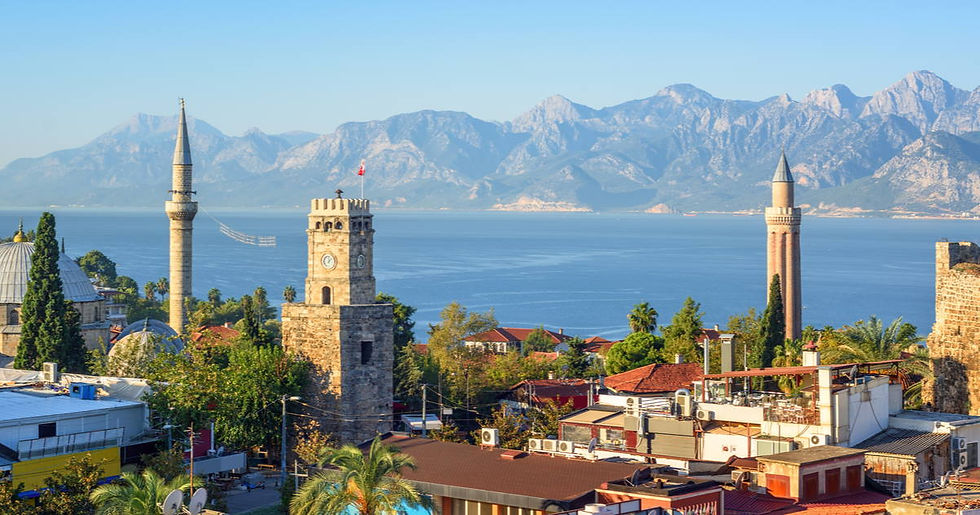
Our stay in Antalya was very short. It was a rainy day.
Antalya Old Town, locally known as Kaleiçi, is the historical and cultural heart of Antalya, Turkey. Enclosed by ancient city walls, this 2,200-year-old district is a maze of cobblestone streets, boutique hotels, and traditional Ottoman-era houses, blending Roman, Byzantine, Seljuk, and Ottoman architectural influences.
Kaleiçi is located in the city center of Antalya and is home to boutique hotels, historical artifacts, museums, specially designed stores, stylish cafés and restaurants, Kaleiçi is surrounded by walls inside and outside in the shape of a horseshoe. Walls are known to be the common work of the Hellenistic, the Roman, the Byzantine, the Seljuk and the Ottoman periods. There are about 3000 houses with tile roofs inside the walls. The architecture of Kaleiçi outside the walls, on the other hand, bears the traces of the Ottoman architecture. The characteristic structures of the houses not only give an idea about the architectural history of Antalya, but also reflect in the best possible manner lifestyle, traditions and the customs in the region in the best possible manner.
It is possible to enter Kaleiçi through Hadrian's Gate (Hadrian Kapısı). This gate is one of the best-preserved historical buildings in Antalya. The building is a Roman work which was built during 130 CE in the name of the Roman Emperor Hadrian.

One of the most important buildings in Kaleiçi is the Yivli Minaret Complex (Yivli Minare Külliyesi). Kulliye is a collection of buildings from the Seljuk period. The main buildings in the complex are: Yivli Minaret, Yivli Mosque (Yivli Cami), Gıyaseddin Keyhüsrev Madrasah (Gıyaseddin Keyhüsrev Medresesi), Selçuklu Madrasah (Selçuklu Medresesi, Mevlevi Lodge (Mevlevihane), Zincirkıran Turbah (Zincirkıran Türbesi) and Nigar Hatun Turbah (Nigar Hatun Türbesi). Yivli Minaret is one of the first Islamic buildings in Antalya. It is an eighth century Seljuk building.

Just south to Kaleiçi is the Historical Marina. Dozens of cruise boats are anchored in the marina which is in the safe bay. With these boats, you can make daily tours to see the cliffs and waterfalls.

Pamukkale
Pamukkale Turkey is a stunning natural wonder that attracts millions of visitors every year from all over the world. Located in the province of Denizli in southwestern Turkey, Pamukkale Turkey is a UNESCO World Heritage Site that is famous for its white travertine terraces and crystal clear thermal pools.
Cleopatra’s antique Pool
Fresh deposits of calcium carbonate give these formations a dazzling white coating. The Turkish name Pamukkale, meaning “cotton castle”, is derived from this striking landscape.
Pamukkale, translating to "Cotton Castle" in Turkish, is a stunning UNESCO World Heritage site in southwestern Turkey famous for its cascading white travertine terraces and mineral-rich thermal waters. Located in the Denizli Province, it offers visitors a unique combination of natural thermal spas and the sprawling ruins of the ancient Roman city of Hierapolis
Outstanding Universal Value
Deriving from springs in a cliff almost 200 m high overlooking the plain of Cürüksu in south-west Turkey, calcite-laden waters have created an unreal landscape, made up of mineral forests, petrified waterfalls and a series of terraced basins given the name of Pamukkale (Cotton Palace). Located in the province of Denizli, this extraordinary landscape was a focus of interest for visitors to the nearby Hellenistic spa town of Hierapolis, founded by the Attalid kings of Pergamom at the end of the 2nd century B.C., at the site of an ancient cult. Its hot springs were also used for scouring and drying wool. Ceded to Rome in 133 B.C., Hierapolis flourished, reaching its peak of importance in the 2nd and 3rd centuries A.D., having been destroyed by an earthquake in 60 A.D. and rebuilt. Remains of the Greco-Roman period include baths, temple ruins, a monumental arch, a nymphaeum, a necropolis and a theatre. Following the acceptance of Christianity by the emperor Constantine and his establishment of Constantinople as the ‘new Rome’ in 330 A.D., the town was made a bishopric. As the place of St. Philip’s martyrdom in 80 A.D., commemerated by his Martyrium building in the 5th century, Hierapolis with its several churches became an important religious center for the Eastern Roman Empire.
The combination of striking natural formations and the development of a complex system of canals, bringing the thermal water to nearby villages and fields, is exceptional. The springs are the source of a hydraulic system extending 70 km northwest to Alasehir and westwards along the valley of the Menderes River. Pamukkale forms an important backdrop to the original Greco-Roman town of Hierapolis and the cultural landscape which dominates the area.
Hydrotherapy was accompanied by religious practices, which developed in relation to local cults. The Temple of Apollo, which includes several Chtonian divinities, was erected on a geological fault from which noxious vapours escaped. The theatre, which dates from the time of Severus, is decorated with an admirable frieze depicting a ritual procession and a sacrifice to the Ephesian Artemis. The necropolis, which extends over 2 kilometres, affords a vast panorama of the funerary practices of the Greco-Roman era.
The Christian monuments of Hierapolis, erected between the 4th and the 6th centuries, constitute an outstanding example of an Early Christian architectural group with a cathedral, baptistery and churches. The most important monument, situated outside the north-west wall of the city, is the Martyrium of St. Philip. At the top of a monumental stairway, the octagonal layout of the building is remarkable because of its ingenious spatial organization.
Most of the property is free of modern buildings and the architectural monuments can easily be appreciated. Some old monuments are in use again, for example the theatre is used for performances with participation of thousands of people, while excavation and restoration works on the site are still going on.
The monumental and archaeological remains truthfully and credibly express the Outstanding Universal Value of the property in terms of its setting, form, and materials.
Cappadocia
Cappadocia really is one of those once-in-a-lifetime experiences…Our FAVORITE thing we saw in Cappadocia was this sunrise hot air balloon ride! Floating above the valleys as hundreds of colorful balloons filled the sky was one of the most unforgettable moments of our trip. The early wake-up call was so worth it for those unreal views!
Photos of the the extraordinary landscape, fairy chimneys, cave dwellings.
Konya
Konya is a city south of Ankara in Turkey’s Central Anatolia region. It’s a pilgrimage destination for Sufis, focused on the tomb of the founder of the Mevlana order, Jelaleddin Rumi, in the Mevlana Museum. Sema whirling dervish ceremonies take place at the Mevlana Cultural Center, east of the museum. The 12th-century Alaeddin Mosque is surrounded by the green parks of Alaeddin Hill.
Konya, located in central Turkey on the Anatolian Plateau, is one of the country's oldest and most spiritually significant cities. Renowned as the home of the famous poet Rumi and the birthplace of the Whirling Dervishes, it serves as a major hub for Sufi culture and Islamic heritage.


Comments