MANALI & More - 1956

MANALI - 1
Our first visit to Manali was with my father and mother. He was to attend a conference at Lake Nainital. As I have mentioned earlier that he was very fond of travelling. I remember I had already finished my first year at Medical college.
He planned to go to Manali before going to conference in Naintal.

Manali is one of the most beautiful towns in the Kullu Valley of the State of Himachal Pradesh. The town is located at a height of 6,398 ft. It is situated near the northern end of the Kullu Valley.

We flew to Chandigad - capital of the new state. My father carried a map for the route we should follow. On reaching there we were told since Bhakra dam is built we must change our route and it will be longer via Mandi. The good thing was that we got to see the first major dam built after Independence. On the way we stayed for one night in Mandi. Next morning the collector took us to see a beautiful Rock garden he had planned. On our way to Kulu we saw a cricket match being played there.
Our stay in Manali was booked in government guest house. When we reached there, one family was using the other half of cottage. We adjusted to stay in the other half. They were youngsters, we became friends. Our stay was short. The weather in Manali at that time of the year was cold. Our driver use to put big block of log in the fire at night , so that we can remain warm. We noticed that John Bannon’s hotel was very popular and most of the people staying there were Europeans.

We visited the near places. Hidamba Devi temple and a place where there are hot water springs. Weather took a sudden change and there was snowfall all around. So going to Rhotang top, was out of question. After crossing the Rhotang the road goes up to Leh. For our return journey the roads were covered with snow and it was impossible to cross the road near Kulu. Arrangements were made so that we got out of our car. May be stayed for one night in Kulu. My mother bought a typical Kulu shawl which I have preserved all these years. Another car came from the other side and only after than we could reach Nainital.

It was a long journey, when we reached Nainital, our stay was at a Bungalow high up on the top. My father preferred to change our accommodation and we moved to a club house which was at the level of lake. While he attended the meeting, we two sisters went riding on the horse at Top of a hill from where we could see some part of Himalayan range - we were accompanied by two boys who were sons of my father’s friend whom we knew. Time and cold weather didn’t permit and when the meeting ended we flew back to Mumbai.
MANALI - 2
I went to Manali for the second time after attending “ World Congress Of Paediatrics “ in Delhi. My parents were in Delhi, and Sonali was with them at home. At the end of conference we three my husband, my daughter and me left for Manali.
It was during the festive season of Diwali and the houses were lit up with small Diyas - lights which made it look very beautiful. Our old friends who were our neighbours suggested for us at John Banon’s popular hotel.

The high point of the visit was that weather was kind enough to go to Rhotang pass. My husband was reluctant so - only I went with my daughter by bus. The bus was full of mostly people from Bengal - I was surprised to see one of the most popular film producer from Bengal was sitting on the front seat. He was the famous Satyajit Ray. Pather Panchali (1955) was written, directed, and produced by Satyajit Ray in his feature film directorial debut, with the government of West Bengal acting as the primary financial producer.
Surroundings of Rhotang seen from the road were beautiful. We were not bold enough at that time to walk around - but we enjoyed.
We visited the famous Hidamba Temple. Our friends had invited us to visit their home - which was located on the outskirts of town. May be they picked us up and also brought us back.
Our return journey - I don’t have good memory but we returned to Delhi by a
bus at midnight.
MANALI - 3
For this trip we went to Manali after Covid epidemic. We were five ladies and all of us had been to Manali at least once.
My sister had made a reservation in a private property earlier - the owner of this had his own house just across the road. He kept in touch with her sending photos of snow all around. This was the main reason that we went to his place.
Our kitchen was managed by his staff. Apple season was almost coming to an end and truck loads of Apples from his farm were being sent outside. His old mother was supervising and taking care of separating the apples. We were happy to see our garden full of Apple trees.
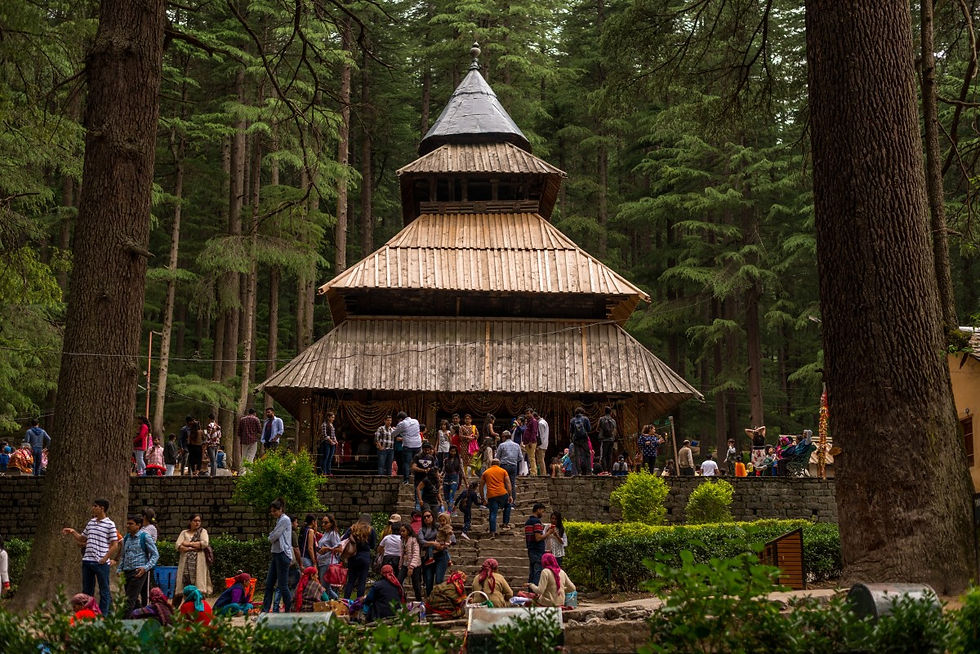
After visiting Hidamba temple, which was quite a scene - crowded with visitors busy wearing local out fits and photographed.
After this - most of the time was spent in shopping for Kulu Shawls. On the third day me, my sister and one more friend visited Rhotang pass. There was lots of snow all around. The top of the mountain was crowded with people and horses.
We spent a day relaxing there - watching clouds over the hills was enjoyable.
Leaving was painful but we had other places on our Agenda.
Naggar
The Ancient Capital of Kullu

On our way we went to ‘ Naggar ‘ located on the opposite side Of Kullu town. It was the ancient capital of the Kullu Kingdom .
Naggar was founded by Raja Visudh Pal and remained the seat of the Kullu rulers for many centuries. The capital was later shifted to Sultanpur, in present-day Kullu, by Raja Jagat Singh.
The famous Naggar Castle stands as a reminder of its royal past. It is a beautiful stone-and-wood structure, traditionally attributed to Raja Sidh Singh and believed to have been built around 1460 AD. The castle was once a royal residence and is now preserved as a heritage property.
The Roerich Connection
Naggar has another important connection — with the family of the Russian artist and philosopher Nicholas Roerich. Nicholas Roerich came to Naggar in 1929 and made the beautiful Himalayan surroundings his home. His son, Svetoslav Roerich, was also a painter. Svetoslav married Devika Rani, one of the pioneers of Indian cinema and a co-founder of Bombay Talkies.
The Roerich family estate and art gallery have become important attractions of Naggar. The beautiful Himalayan landscape inspired the artists, and their work remains closely associated with the place.
We visited the Roerich Art Gallery first. From there, we could enjoy the view of the back side of the hill. We also walked around their house. I remember the unique old furniture, which gave the place a special charm.
It was interesting to visit a place that had once been the capital of the Kullu Kingdom and had later become home to a family of artists. The combination of history, art and the beauty of the mountains made Naggar a memorable stop on our journey.
Tirthan Valley.

Our plan to was to visit both Parvati and Tirthan Valley. Both valleys are run parallel northwards. Conidering lack of time we decided on Tirthan valley. We reached rather late in the evening. On reaching there we found that our accommodation required going deep down to the compound. With the help of staff we managed the steps along the steep slope. We spent the night at this private property. It had four independent rooms scattered around in the compound. Dininng room was well decorated and food was nice. We had no choice but to stay there for the night. We instructed our driver who was going for his dinner to find a suitable place.

Next morning he showed us photos of the interior of this small two story hotel. He described that it was close to river and had enough room for parking the cars. This place had all the proper facilities so we shifted there. The three senior ladies took separate rooms on the ground floor. Me and my sister stayed togather in one room. The name of the place was Usha Cottage.
Next day arrived a car full of young boys from Delhi. They used the two rooms next to us. At night they sounded noisy as they were singing. But it was nice to have these young people around.
Our meals were served in the gallery close to our rooms .In the evening we walked along the main road as far as the market. Right across was another nice property, to get there we crossed by a hanging basket.
Next day we went for an outing up to Banjar where there was a temple. We sat on the steps. The youngsters had gone for adventures walk.
The next day they were leaving - they requested if they could take a photo of us senior ladies, as they wanted to show their mothers the photo for inspiration as the mothers may not be travelling.

Shoja
My another trip in Himachal Pradesh was from Shoja to Kalpa and further downwards to Sangla.

Shoja was not too far from Banjar. Shoja’s beauty was filled with rich valleys and fascinating view of snow covered peaks to see and enjoy.
We stayed in Shoja at a hotel where we had to walk down the steps. The hotel office was right at the top. We were seven of us - we were allotted rooms the same way. Each family was allotted rooms - one below the other at three levels.
Every time one wants to go out you have to climb several steps. This was steep and strenuous.

On the first day we relaxed and watched the star filled sky. Next day after breakfast we walked up. And went for an nature walk and bird watching along a road in a jungle. There was nothing much to be seen but it was safe and we walked leisurely.
Next day we three of us decided to relax. Our friends decided to go to lake Serolsar lake.
Sarahan
It is situated in the district of Himachal Pradesh in Sutlej valley. Sarahan, a hidden gem nestled in the Himachal Pradesh, beckons travelers with its serene beauty and spiritual significance. It is a gateway to the Kinnaur valley and further to the mighty Spiti valley.

This quaint village was once the summer capital of the rulers of the Bushahr kingdom. It is where mountain meets serenity.
Misty mountains, ancient temples, and unforgettable Himalayan views. Welcome to Sarahan, one of Himachal Pradesh's most beautiful hidden treasures. Sarahan sits on the main mountain route leading into the Kinnaur region, earning it the popular title of the "Gateway to Kinnaur".

A sacred pilgrimage site
It is famous for the ancient Bhimakali Temple. An 800-year-old pilgrimage site and one of the 51 Shakti Pithas, featuring a unique blend of timber and stone architecture designed to withstand earthquakes.

The village is renowned for the Bhimakali Temple, dedicated to the goddess Bhimakali, the presiding deity of the former Bushahr state. The Bhimakali Temple traces its origins back 800 years, making it a repository of centuries-old traditions and spiritual fervour.
The temple is dedicated to Goddess Durga, affectionately known as Bhimakali by the locals. Among the 51 sacred Shakti peethas scattered across the Indian subcontinent, the Bhimakali Temple holds a special place. Devotees believe that the temple houses a fragment of the divine feminine energy, making it a powerful pilgrimage site.
The temple’s architecture is a blend of Himachali and Indo-Tibetan styles. Its intricate woodwork, adorned with mythical motifs and celestial beings, captivates visitors. The exterior, embellished with ornate carvings, reflects the devotion poured into its construction.
Sarahan, a hidden gem nestled in the Kinnaur Valley of Himachal Pradesh, beckons travelers with its serene beauty and spiritual significance. It is a gateway to the Kinnaur valley and further to the mighty Spiti valley.
Sangla
Sanglais is a town in Basra valley, in Kinnaur district of Himachal Pradesh, close to border of Tibet. Sangla sits at a lower elevation about 2,680 meters in the Sangla valley .

Chitkul sits higher up at about 3459 meters and is about 1 - hour drive past Sangla.
Batseri is a scenic, offbeat village located in the Sangla (Baspa) Valley of the Kinnaur district in Himachal Pradesh, India.

Key Highlights of Batseri Village situated on the left bank of the Baspa River, roughly 7 kilometers before Sangla town as you head toward Chitkul.

Architecture: Famous for its traditional Kath-Kuni style architecture—flat-roofed wooden houses featuring intricate carvings and stone-paved narrow lanes.
Kalpa
Kalpa is a scenic heritage village located at an altitude of 2,759 meters in the Kinnaur district of Himachal Pradesh . The snow capped peaks provide a dramatic backdrop, glowing gold and crimson during sunrise. Hindu and Buddhist legends consider the mass winter home of Lord Shiva.

Kalpa is famous for its stunning views of the sacred Inner Kailash mountain range and its towering 79 foot rock pillar that changes colour throughout the day.
It sits above the town of Reckong Peo in the Sutlej river valley and offers stunning views of the Kinner Kailash mountain range. The Baspa River originates near the Indo-Tibetan border in the Baspa Hills and is fed by the perennial Chung Sakhago Glacier near the Chung Sakhago Pass in the Himalayas.
Baspa River is a river flowing through the Indian Himalayas in the northern Indian state of Himachal Pradesh. It rises near the Indo-Tibetan border and forms the scenic Baspa Valley before flowing into the Sutlej River from the left bank near Karcham, where the Karcham Wangtoo Hydroelectric Plant is located on it.
Rich heritage heritage and Architecture - Traditional wooden Kinnauri houses with slate roofs line the narrow lanes .
Historical Significance: Once the former headquarters of the Kinnaur district, Kalpa grew as a major stop along the ancient Hindustan-Tibet trade route.

The breathtaking view of Kinner Kailash from Kalpa, Dominating the skyline from Kalpa is the sacred Kinner Kailash peak. Standing tall at approximately 6,050 meters (19,819 feet), it holds immense religious significance for Hindus and Buddhists alike.
Chitkul: Known as the last inhabited village near the Indo-Tibetan border, famous for its wooden houses and scenic meadows along the Baspa River. People visit there and take photos of the local school.


Comments